Found out at the packing bench
Opening the last carton leaves little time to arrange a reprint. Agree a fallback before a shortage forces a last-minute change to the customer experience.
Keep mailers, labels and inserts in view: connect stock counts, usage by SKU and reorder timing.
On-hand stock · SKU usage · Reorder planning

Three gaps that make a low-cost item difficult to replace in time.
Opening the last carton leaves little time to arrange a reprint. Agree a fallback before a shortage forces a last-minute change to the customer experience.
Total order volume does not show how many size-M mailers, hang tags or cards each product consumes. Track the combination used by each SKU.
Production and inbound transport both take time. Balance the replenishment window against storage needs and any planned artwork changes.
Packaging stock management tracks how much of each packaging item you have, how fast each SKU uses it and when to reorder. It treats packaging as inventory with its own counts and lead times, rather than an untracked supply cupboard.
Start with stock on hand, usage per week and the total replenishment lead time. Include production, inbound transport and a safety buffer. Agree who records receipts, packed-order usage and stock adjustments.
Link each packaging item to the SKU rules that use it. A size-M mailer may serve several sizes of a shirt; a gift box may belong to just one bundle.
A useful stock view shows what is on hand, where it is used and the estimated cover at the current usage rate. Confirm data sources, update frequency and reporting access for your project.
| Item | Used by |
|---|---|
| MLR-NVY-M | TEE-NVY-S/M/L, POLO-NVY-M |
| TAG-HANG-STD | All apparel SKUs |
| CARD-THANKS | All orders |
| BOX-GIFT-L | BUNDLE-GIFT only |
Example view. Divide verified units on hand by average weekly use to estimate cover in weeks.
Swipe or use the arrow keys to view all columns.
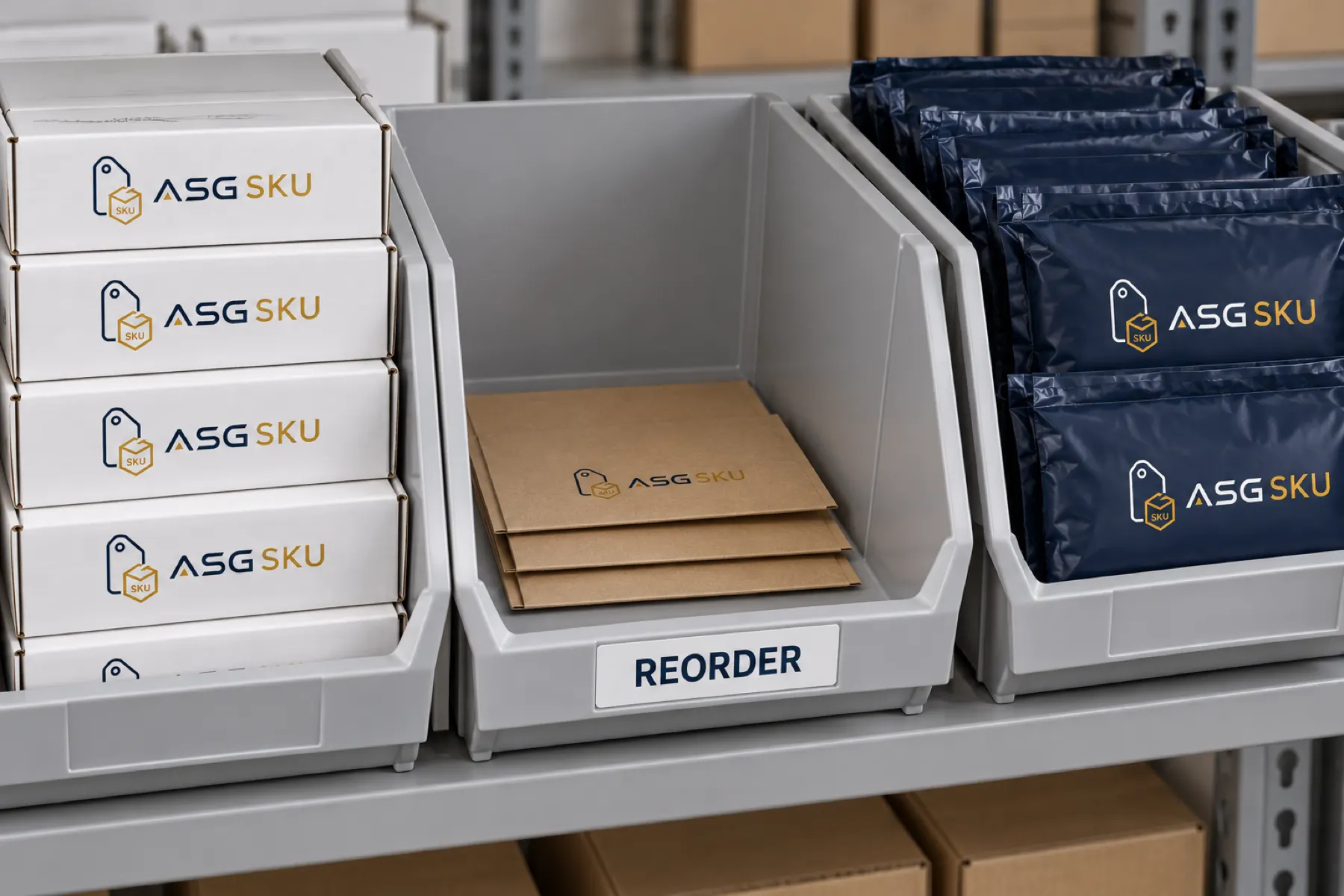
Base the point on weekly usage, the full replenishment lead time and a safety buffer. Specify who receives the low-stock alert and how it is sent.
Compare recent usage, upcoming promotions and supplier order quantities. Confirm the quantity and quote before placing a reprint order.
Record the remaining old artwork and its planned end date. Decide whether to use it up, hold it or write it off before ordering a new version.
Read the packaging stock management guide

One design across several mailer sizes, plus tags and size stickers. Count each item separately: the sizes can run down at different speeds.

A gift box reserved for one bundle can move quickly during a promotion. Keep that stock separate from everyday packaging and include campaign demand in the plan.

Campaign cards have an end date. Track the remaining version and campaign dates so a routine reorder does not replenish an expired message.
Agree the record, owner and update method at each handoff.
Identify each design and size with its own item code. Record received units and any damaged stock.
Map the item to the SKU rules that consume it, including bundles and order exceptions.
Reconcile packed-order usage with remaining stock. Record damage, samples and corrections separately.
Compare stock cover with replenishment time. Agree the alert method, review frequency and fallback.
Approve the quantity, artwork and quote. Track the expected arrival and count the new stock on receipt.
Track material costs and agreed handling charges.
Scroll across to compare all specifications.
| Item in the order | Unit cost | Qty | Calculation |
|---|---|---|---|
| Branded mailer · M | Quoted per item | 1 | Unit cost × qty |
| Hang tag | Quoted per item | 1 | Unit cost × qty |
| Thank-you card | Quoted per item | 1 | Unit cost × qty |
| Pack-out, if agreed | Quoted per order | 1 order | Agreed handling charge |
| Total per order | Materials + agreed handling |
Example packing rule. Quantities are examples; unit costs and any handling charges are confirmed in your quote.
A spreadsheet or connected system can work. Compare the record and responsibilities, not just the software name.
Scroll across to compare all specifications.
| Requirement | Spreadsheet workflow | Connected workflow to confirm |
|---|---|---|
| Stock movements | Log receipts, usage and adjustments | Confirm which movements are imported or recorded |
| Usage by SKU | Maintain the item-to-SKU mapping | Confirm how packing rules feed item consumption |
| Low-stock alerts | Review counts against a reorder point | Confirm trigger, recipient and delivery method |
| Reorder quantity | Review usage and supplier minimums | Confirm suggestions and approval before ordering |
| Reconciliation | Schedule physical counts and corrections | Agree count frequency and discrepancy handling |
Planning comparison only. ASG SKU integration, automation and reporting scope require confirmation.
Separate storage, record keeping and replenishment when reviewing the quote.
Ask for the storage unit, billing period and treatment of slow-moving or obsolete packaging. Confirm the rate and any minimum charge.
Define receipt counts, usage updates, reporting and additional cycle counts. Confirm what is included and what is separately charged.
Compare material, print colors, artwork version and order quantity. Production and freight costs belong in the replenishment plan.
Counts, replenishment and cost, explained without a software demo.
Orders may wait or use substitute packaging, depending on the fallback you approve. Specify the decision for each item, who authorizes substitutions and whether an optional insert can be omitted.
Multiply weekly usage by total replenishment lead time in weeks, then add a safety buffer. For example: 200 units per week and three weeks of lead time give 600 units, plus the buffer. Include production and inbound transport in that lead time.
Each SKU rule lists the packaging items and quantities used. Add consumption across the packed orders that use each item, then reconcile damaged units, samples and adjustments. Confirm whether records are manual or integrated and how often they update.
Multiply each packaging item’s unit cost by the quantity used, add the item costs, then add the applicable pack-out fee. Calculate different combinations separately when bundles or special inserts change the contents.
Include supplier-provided packaging in your request with its item list, quantities, dimensions and intended SKU rules. Acceptance, inspection, storage and stock-record requirements need confirmation before shipment. Start a project with your SKU list.
Share your SKU list, packaging items and current quantities to discuss stock responsibilities and replenishment needs.
Fields marked are required. Select all packaging types that apply.
Add these details to your project notes.